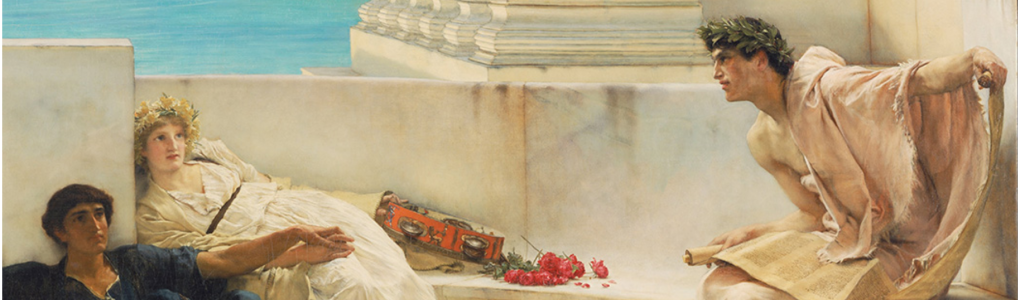
Alma-Tadema, A Reading From Homer

Greek and Latin

The dual-language major in Greek and Latin provides intensive training in both classical languages, enabling students to read ancient literature, philosophy, and history directly in original Greek and Latin texts.

πŸ—ΊοΈ Planning Your Degree: Explore semester-by-semester roadmaps and degree planning tools on the Greek & Latin Major Map.

πŸ“Œ Prerequisite to Declare
  • Course Prerequisite: Successful completion of at least one UC Berkeley Greek or Latin course is required before declaring the major.

Major Requirements

The major combines elementary language preparation, upper-division language reading, foundational classical surveys, and upper-division departmental coursework.

1. Elementary Language Sequences (16–20 units)

Complete elementary coursework in both languages:

  • Greek Sequence: Greek 1 + 2 or Greek 15
  • Latin Sequence: Latin 1 + 2 or Latin 15
  • Recommendation: Do not start both languages simultaneously. It is recommended to start on elementary course and start the second one the next year, or take the summer workshop the summer after completing the first language elementary sequence
  • Note: Requirements in this section may be partially or completely waived through placement exams or faculty evaluation. Sign up for the Latin Placement Exam. Consult directly with Elementary Greek instructors or Faculty Advisors to determine proper placement.

2. Ancient Mediterranean Survey Courses (8 units)

Select two of the following survey options (AGRS 10A, 10B, and R44 are preferred):

  • AGRS 10A (Ancient Greece)
  • AGRS 10B (Ancient Rome)
  • AGRS R44 (Ancient Greece and Rome: Literature and Writing) (Ancient Greece and Rome: Literature and Writing)
    • Note: AGRS R44 satisfies the second half of the L&S Reading and Composition requirement (R&C Part B) and can replace either an "A" or "B" survey course.

3. Core Upper-Division Language Sequence (16 units)

Complete the following four courses:

  • Greek 100
  • Latin 100
  • Either Greek 101 or Greek 102
  • Either Latin 101 or Latin 102
  • Substitution Note: Students who place out of Greek 100 or Latin 100 must substitute another upper-division class in that language.

4. Upper-Division Language Electives (8 units)

  • Complete two additional courses chosen from Greek or Latin.
  • One of these two courses may be an unused 101 or 102 course in either language.

5. Upper-Division Departmental Elective (4 units)

  • Complete one upper-division AGRS course (4 units) offered by the department.

πŸ“ Language Placement

Latin Placement
  • Placement DiagnosticStudents can place out of the elementary Latin sequence and directly into Latin 100 or higher by taking the Latin placement exam. Sign up for the Latin Placement Exam.
  • AP CreditHigh scores on the AP Latin exam frequently place students into Latin 100, granting 4 units of credit (equivalent to one course) for placing out of Latin 1 and 2.
Greek Placement
  • No Placement ExamThere is no formal placement test for Ancient Greek.
  • Advising: Students with prior experience in ancient Greek should consult directly with Elementary Greek instructors or Faculty Advisors to determine proper placement.

πŸ”„ Transfer Course Credit

Coursework completed at other colleges or universities may be applied toward language major requirements following review and approval.